
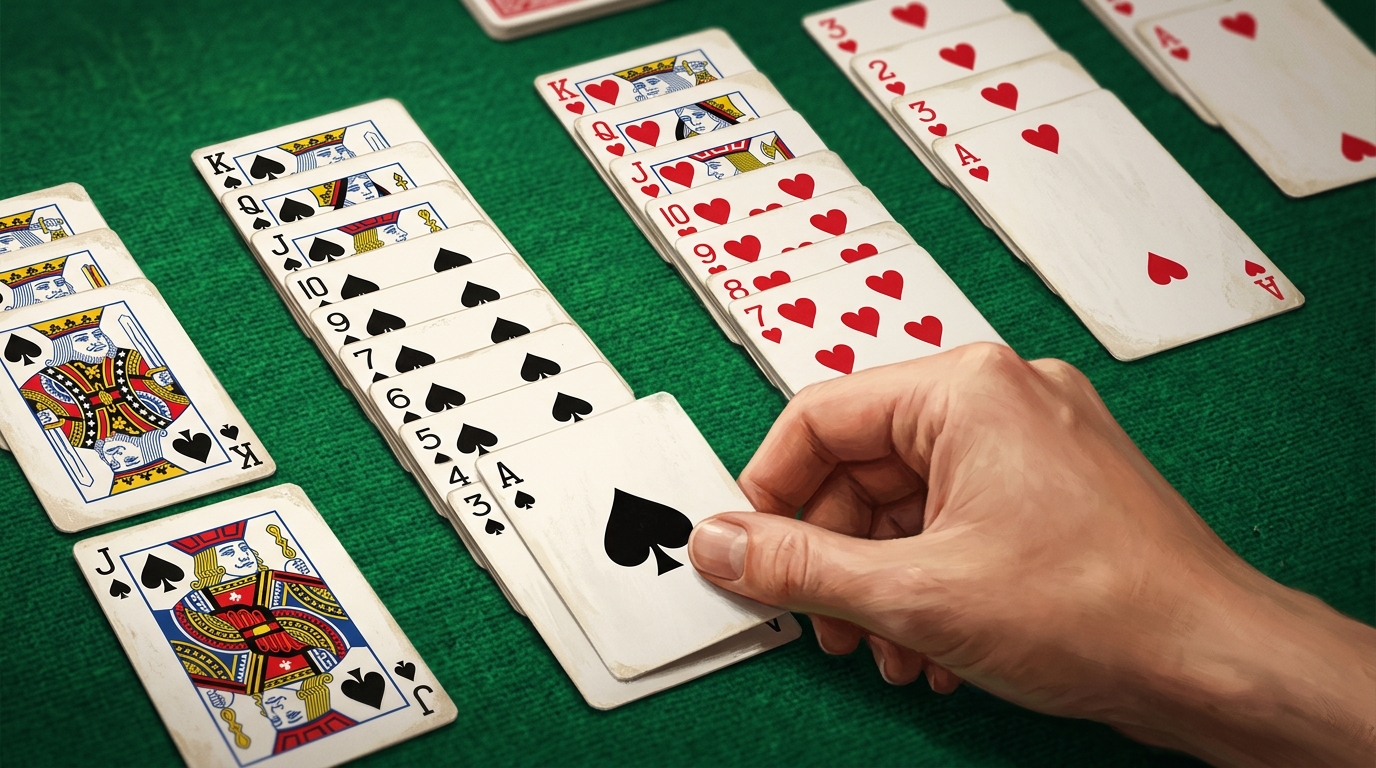
Spider Solitaire Aarp belongs to a wider story about how puzzles move between pages, books, websites, and apps. Suit modes are not just difficulty labels; they change how much information each move leaves on the table. Each medium changes the player’s routine a little. A newspaper creates a daily appointment, a book creates a collection, and a browser makes the next board almost frictionless. The puzzle stays recognizable, but the reason people return can change with the format.
Spider Solitaire Aarp in practice
A difficult mode makes a good digital product
Spider is a natural fit for software because its difficulty can be adjusted without changing the basic identity of the game. One-suit play gives a gentle introduction. Two suits add planning. Four suits make the player manage several competing structures at once. A site or app can offer those modes side by side, turning one card game into a small progression system.
That progression is a publishing advantage. A player who finishes a familiar mode has a clear next step instead of a reason to leave. The content is not only a deal; it is a path through different ways of reading the same tableau.
Why browser and app play keep the habit alive
The browser removes setup time and the app makes the game portable. Both formats support short sessions, but they also preserve long-term memory. A player learns which kind of move usually creates trouble, which suit mix feels dangerous, and when the stock is likely to punish impatience. Those lessons make the next board personal even when the rules stay fixed.
Digital publishing also makes explanation easier. A page can place a rule next to a playable board and let the reader test it immediately. That connection is one reason classic card games continue to find new players.
Choose the mode that matches your attention
Try Spider Solitaire on Easy Daily Puzzle and find more Spider articles on this site. Microsoft’s history shows how the desktop shaped the format, while the Spider overview) explains the family of modes.
Turn the format into a useful routine
Before making a move, count the useful spaces on the board. Empty columns, reachable face-down cards, and same-suit runs are not equal, but they are all forms of leverage. A move that preserves two of them may be stronger than a move that creates one attractive stack. This is why Spider often rewards restraint even when several legal moves are available.
Mixed-suit stacks deserve special attention. They can move, but they usually cannot be treated as one clean unit until the suits align. If you move one too early, you may bury a card that would have repaired another column. Try to expose information before you rearrange the visible surface.
Treat the stock as a commitment. Once a deal adds cards to every column, the board may lose the clean spaces you were protecting. Use the visible tableau first, then deal when the remaining moves are genuinely limited. After the deal, pause and identify the new longest run, the new blocked column, and the card that became reachable.
For the next session, play a Spider board on Easy Daily Puzzle and browse more Spider Solitaire strategy on this site. A good review asks which move reduced future choices. That question improves planning more reliably than simply replaying the same board until it finally works.
The small detail worth remembering
The strongest Spider move is often the one that improves the next three moves rather than the one that looks best immediately. Empty columns, hidden cards, and same-suit runs are resources. Spend them when the board gives you a clear return.
A loss can still be a good session if it reveals the cost of one decision. Review the first moment when the tableau became less flexible, then enter the next deal with that specific warning in mind. Planning grows from concrete mistakes.
When several moves look legal, choose the one that reveals the most information while preserving the most space. That single filter removes many attractive but unhelpful clicks.
For a little more context, read Microsoft’s history of Solitaire on Windows and Spider Solitaire background. These references are useful for checking the basic history or rules without turning a daily game post into a long reference list.